Overview
The Ancient Tea Road of Southwest China is a network of pack-horse and porter routes connecting the tea districts of Sichuan, Guizhou and Yunnan. It runs from Mengding Mountain in Ya'an through Qionglai, Yibin, Bijie, Zunyi, Meitan, Guiyang, Duyun, Anshun, Qujing and Kunming, and the migrated record also extends it toward Pu'er. The route is associated with Mengding Ganlu, Mengding Huangya, Duyun Maojian, Meitan Cuiya, Yibin black tea and Qionglai dark tea. It is not the same as the Yunnan–Tibet Tea Horse Road, although the two networks meet at Kunming and share some trade teas.
History and background
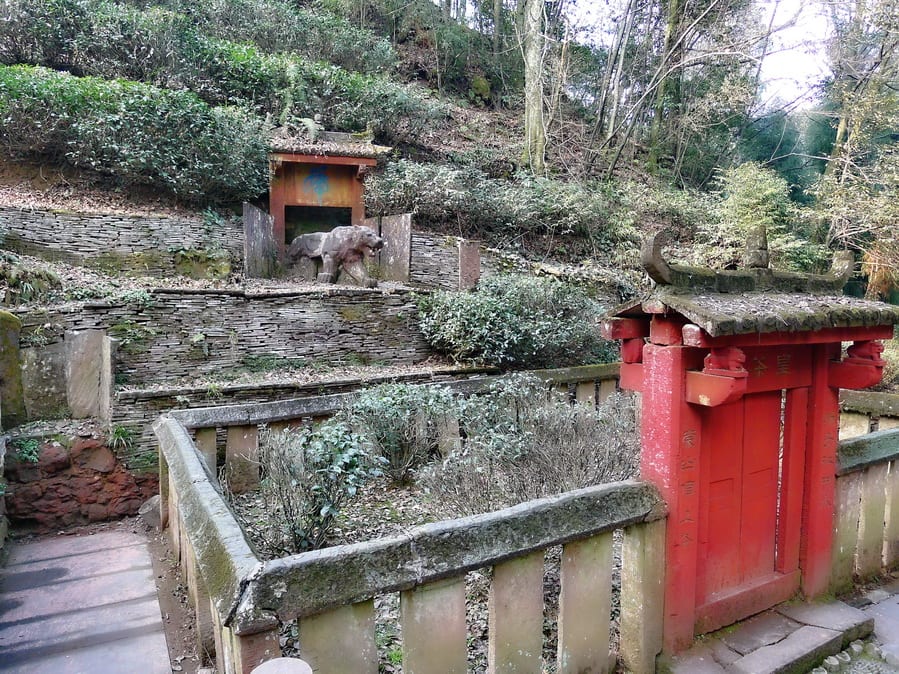
Mengding Mountain: the starting point. Local tradition holds that in 53 BCE, during the Ganlu period of the Western Han, Wu Lizhen planted seven tea trees on Mengding Mountain. The story is one of the earliest recorded accounts of deliberate tea cultivation in China, though it should be read as a traditional origin narrative rather than as an audited agricultural record. Mengding Mountain rises to about 1,456 metres and is often wrapped in cloud; the phrase "tea from the top of Mengding, water from the heart of the Yangtze" became a standard image in Chinese tea writing. Mengding Ganlu was among the early tribute teas of the Tang period. Farmers carried tea down from the mountain in back baskets; at Ya'an it was gathered and passed to caravans heading south.
Qionglai and the Linqiong road. From Mengding, the route went east about sixty li to Qionglai, historically Linqiong. Linqiong was one of the starting points of the southwestern silk road, the Shu-Shendu road, which predates the better-known northern silk road. Qionglai dark tea, a post-fermented tea pressed into bricks, was well suited to animal transport. The old wharf at Pingle on the Baimo River is still associated with the route: tea bundles from Mengding were loaded onto boats for the Nan River and carried toward Yibin and Leshan, then transferred to land routes.
Yibin: the Sichuan gateway. Yibin lies at the confluence of the Jinsha and Min rivers and is the first major city on the upper Yangtze. It was the gateway from the Sichuan basin to the Yunnan-Guizhou plateau. Yibin black tea, a congou-style black tea, is one of the better-known Sichuan blacks and is often grouped with Qimen and Dianhong in Chinese tea writing. From Yibin, caravans used the Five-Foot Road and the Southern Barbarian Road to climb into Guizhou and Yunnan. The Five-Foot Road was a Qin-era official route about 1.15 metres wide, the first state-built link between the Sichuan basin and the plateau.
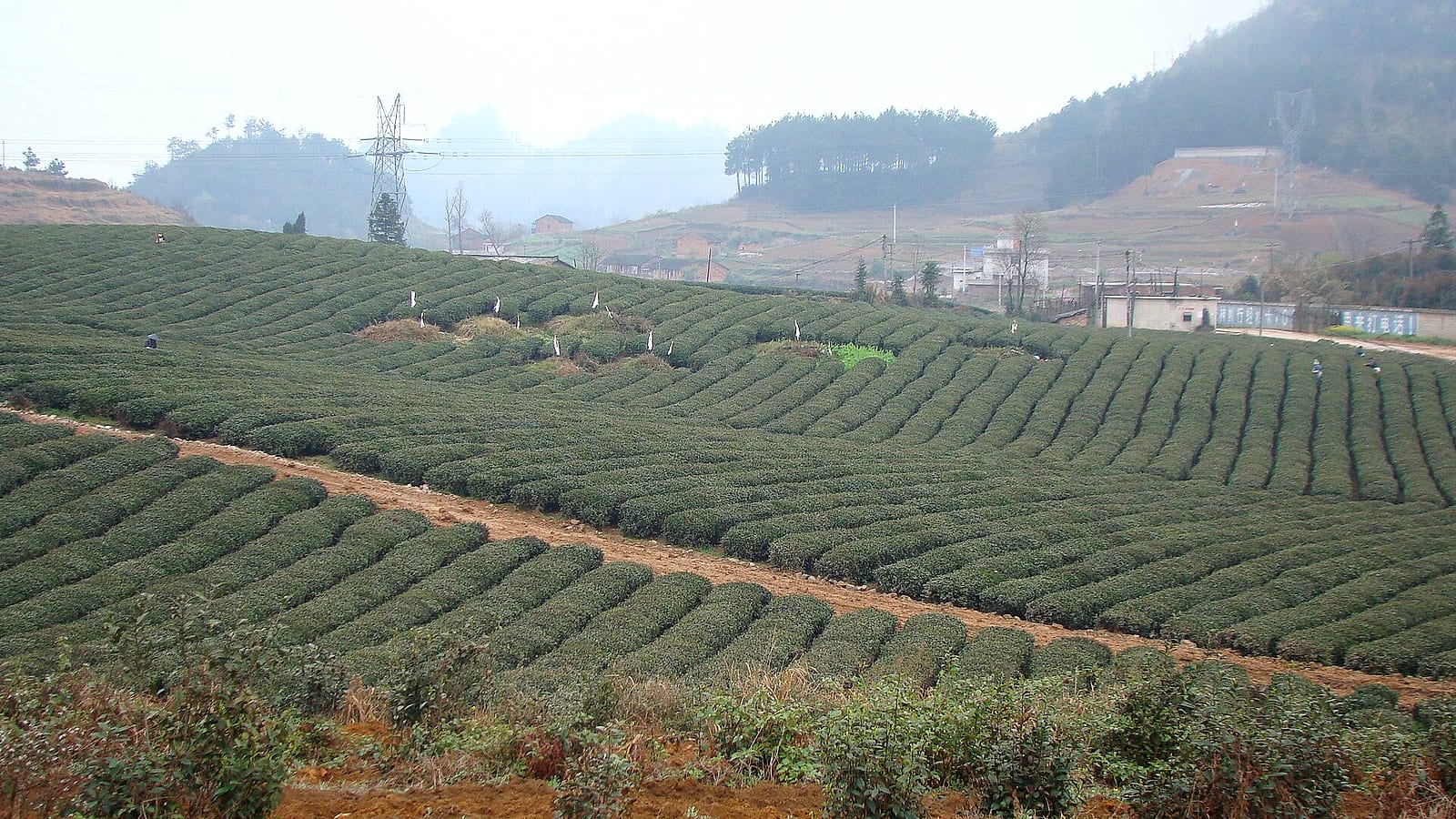
Zunyi and Meitan. The route crossed the Dalou mountains into northern Guizhou. Zunyi was a market and transport town on the Guizhou section, with a tea history reaching back to the Tang period; its modern black tea was developed in the 1940s. Meitan, east of Zunyi, is one of Guizhou's largest tea districts and is associated with the "China Tea Sea", a large contiguous tea landscape. Meitan Cuiya is a flat, smooth green tea. In 1939, during the war with Japan, a central agricultural experiment station was established at Meitan, and Zhejiang University moved there; the town became an important centre for wartime tea research.
Duyun and the karst country. South of Guiyang, the route enters the karst peak country of southern Guizhou. Duyun Maojian, one of China's best-known green teas, comes from the Luosike mountains around Duyun at about 1,738 metres. The tea is often described as "three greens with three yellows": the dry leaf is green with a yellow cast, the liquor is green with a yellow glow, and the infused leaf is green with yellow tones. The karst terrain made the road steep and broken; caravan accounts describe the contrast between the sweetness of the tea and the difficulty of the path.
Guiyang and Kunming. Guiyang, the provincial capital, sits in the middle of the Yunnan-Guizhou plateau and was a natural junction. The northern and southern branches of the ancient tea road met there: one came through Zunyi and Meitan, the other through Duyun. Tea markets in Guiyang still gather produce from across the province. West of Guiyang, the route passed Anshun and Qujing and reached Kunming, the end of the recorded southern line and a meeting point with the Yunnan–Tibet Tea Horse Road. At Kunming, Sichuan and Guizhou teas met Pu'er and Dianhong; from there the Tea Horse Road continued toward Dali, Lijiang and Tibet.
Route and scope
The migrated record gives a route of about 1,500 kilometres from Mengding Mountain to Guiyang and Kunming, with a caravan journey of two to three months one way and a recommended season in March–May and September–November. The shared station table records eight nodes: Mengding Mountain, Qionglai, Yibin, Zunyi, Meitan, Duyun, Guiyang and Kunming. The record also describes a continuation toward Pu'er, but the station table stops at Kunming. The route crosses the western edge of the Sichuan basin, the Yunnan-Guizhou plateau, karst peak country and the central Yunnan plateau.
Distances, elevations and travel times are historical route data. They are not a modern survey, a GPS track or a walking guide. Some sections are now roads or village lanes; others are not publicly accessible. The map and elevation profile on this page use the shared station table, and missing values remain empty rather than being set to zero.
Stations
The stations below use the same node_id as the route fact table. The map and elevation profile are reading aids, not a substitute for field data.
01 · Mengding Mountain · Ya'an
Cumulative distance about 0 km; elevation about 1,456 m; coordinates 30.08, 103.04. Data context: migrated historical route data, not a modern navigation track.
The starting point and the home of Mengding Ganlu. Mengding Mountain, in Ya'an, Sichuan, is the earliest recorded site of deliberate tea cultivation in China: in 53 BCE, during the Western Han Ganlu era, Wu Lizhen planted seven tea trees here. Mengding Ganlu was a Tang-dynasty tribute tea, and “tea from the top of Mengding” became a standard phrase in Chinese tea writing. Farmers carried the leaf down in back baskets, gathered it in Ya'an, and handed it to the caravans that went south — “tea on Mengding’s summit, the road beneath the caravan’s feet.”
02 · Qionglai
Cumulative distance about 60 km; elevation about 500 m; coordinates 30.41, 103.46. Data context: migrated historical route data, not a modern navigation track.
A Qionglai dark tea producing town and an old stop on the tea-horse routes. Qionglai, historically Linqiong, was one of the starting points of the Qin–Han southwestern silk road, the Shu–Shendu road. Its dark tea, post-fermented and pressed into bricks, travelled well by pack animal and belongs to the same family as Ya'an Tibetan brick tea. The old wharf at Pingle on the Baimo River is preserved: tea bundles from Mengding were loaded onto boats, taken down the Nan River to Yibin and Leshan, then moved overland south.
03 · Yibin
Cumulative distance about 250 km; elevation about 280 m; coordinates 28.77, 104.62. Data context: migrated historical route data, not a modern navigation track.
The home of Yibin congou black tea and the hinge between the Sichuan and Yunnan sections. Yibin stands where the Jinsha and Min rivers meet, the first city on the upper Yangtze and the gateway from the Sichuan basin to the Yunnan–Guizhou plateau. Yibin congou is counted among China’s three best-known congou blacks, alongside Qimen and Dianhong, and is known for its high fragrance and strong liquor. The old port was where river and land routes met: Mengding tea changed to caravan here and went south by the Five-Foot Road and the Southern Barbarian Road.
04 · Zunyi
Cumulative distance about 550 km; elevation about 850 m; coordinates 27.72, 106.93. Data context: migrated historical route data, not a modern navigation track.
A Zunyi black tea producing town and a northern Guizhou route centre. Zunyi sits in the Dalou mountains and has long been a corridor between Guizhou and Sichuan. Its black tea was developed in the 1940s and is known for a bright red liquor and a golden rim. The stone-paved Yangliu Street beside the Zunyi Conference site was a caravan route; the old saying runs that Zunyi’s tea fragrance mixes with the smell of revolution and history.
05 · Meitan
Cumulative distance about 630 km; elevation about 780 m; coordinates 27.74, 107.48. Data context: migrated historical route data, not a modern navigation track.
The home of Meitan Cuiya and the “China Tea Sea.” Meitan is one of Guizhou’s largest tea districts and contains a vast contiguous tea landscape known as the China Tea Sea. Meitan Cuiya is a flat, smooth green tea with a bright, pale-green liquor. Caravans passing through saw tea slopes in every direction — “the tea sea at Meitan has no visible edge.” In 1939 the Nationalist government’s central experiment station was set up here, making Meitan one of the birthplaces of modern Chinese tea science.
06 · Duyun
Cumulative distance about 800 km; elevation about 1,100 m; coordinates 26.26, 107.52. Data context: migrated historical route data, not a modern navigation track.
The home of Duyun Maojian and the tea centre of southern Guizhou. Duyun Maojian is one of China’s ten best-known teas, described as “three greens with three yellows”: dry leaf green with a yellow cast, liquor green with a yellow glow, infused leaf green with yellow tones. Its core district is Luosike Mountain, about 1,738 metres high and often in cloud. Caravans crossed the karst peaks on steep, broken paths; a local saying runs: “Duyun’s tea is sweet, Duyun’s road is bitter.”
07 · Guiyang
Cumulative distance about 1,000 km; elevation about 1,050 m; coordinates 26.65, 106.63. Data context: migrated historical route data, not a modern navigation track.
The tea-route hub of central Guizhou. Guiyang, the provincial capital, sits in the middle of the Yunnan–Guizhou plateau and has long been a transport junction. The northern and southern branches of the ancient tea road met here — one through Zunyi and Meitan, the other through Duyun — and continued west together. The Nanming River below Jiaxiu Tower was a caravan stop: “brew Guizhou tea in Nanming water, rest the caravan below Jiaxiu Tower.” Guiyang’s tea market still gathers leaf from across the province.
08 · Kunming
Cumulative distance about 1,500 km; elevation about 1,890 m; coordinates 25.04, 102.71. Data context: migrated historical route data, not a modern navigation track.
The Yunnan hub and the link to the Tea Horse Road. Kunming is the main city of the central Yunnan plateau, the end of the recorded southern line and the starting point of the Yunnan–Tibet Tea Horse Road. Sichuan’s Mengding Ganlu and Yibin congou met Guizhou’s Duyun Maojian and Meitan Cuiya here, together with Yunnan’s Pu'er and Fengqing Dianhong — “Kunming’s tea market gathers the famous teas of the world in one city.” From Kunming the Tea Horse Road ran on through Dali and Lijiang into Tibet.
Trade teas
The old record lists Mengding Ganlu, Mengding Huangya, Duyun Maojian, Meitan Cuiya and Qionglai dark tea, with Yibin black tea also associated with the route. These teas belong to different categories and production methods: green teas from Mengding, Duyun and Meitan; a post-fermented brick tea from Qionglai; and a congou black tea from Yibin. A trade association describes what moved along the route, not a claim that every town produced every listed tea.
Linked tea entries:
Visiting note
The route can be read through tea museums, old wharves, market towns and tea landscapes in Ya'an, Qionglai, Yibin, Zunyi, Meitan, Duyun, Guiyang and Kunming. This site does not provide turn-by-turn navigation or current travel advice. Access, weather, altitude and local conservation rules must be checked independently.
Sources and status
The sources in the record include Chinese local-government and cultural-heritage material; the English text is an editorial translation checked against the Chinese article and retains its historical qualifiers.