Overview
The phrase "Silk Road tea route" suggests a single caravan track running from Chang'an through Central Asia and Persia to Istanbul, and perhaps on to Moscow. The reality was more complicated. The Silk Road itself was a shifting network of oasis, steppe, desert and maritime routes. Tea was one commodity among many, and the kinds of tea, the transport arrangements and the trading rules changed from one period and one branch to another.
This article uses ten nodes as a reading device: Xi'an, Lanzhou, Dunhuang, Turpan, Ili, Almaty, Samarkand, Tehran, Istanbul and Moscow. The station table gives a cumulative distance of about 7,000 kilometres, but that is a map scale, not a journey. Tehran and Istanbul belong to the Persian-Ottoman branch; Moscow belongs to the northern branch that ran through Mongolia, Kyakhta and Siberia. The two branches cannot be joined by continuing north from Istanbul, and the 7,000-kilometre figure should not be read as one caravan's actual route.
History and background
When did tea enter Silk Road trade?
Tea had become a national drink in China by the Tang dynasty, but the sentence "Tang tea travelled the Silk Road on a large scale" needs qualification. Tang tea taxes, tribute tea and border sales were directed mainly toward the northwest and toward Tibet. The volume of tea moving overland was small compared with the brick-tea trade of later centuries. Dunhuang documents and murals show that tea was drunk locally, but they do not prove that a tea caravan route to Persia already existed.
The more reliable turning point came in the Ming and Qing dynasties. Compressed tea was steamed, pressed into bricks and dried. Bricks were compact, resistant to moisture and easy to load on pack animals, which made them suitable for long-distance transport and barter. Jingyang in Shaanxi, Yangloudong in Hubei and Anhua in Hunan developed processing and distribution systems for Fu brick, Qing brick and dark tea.
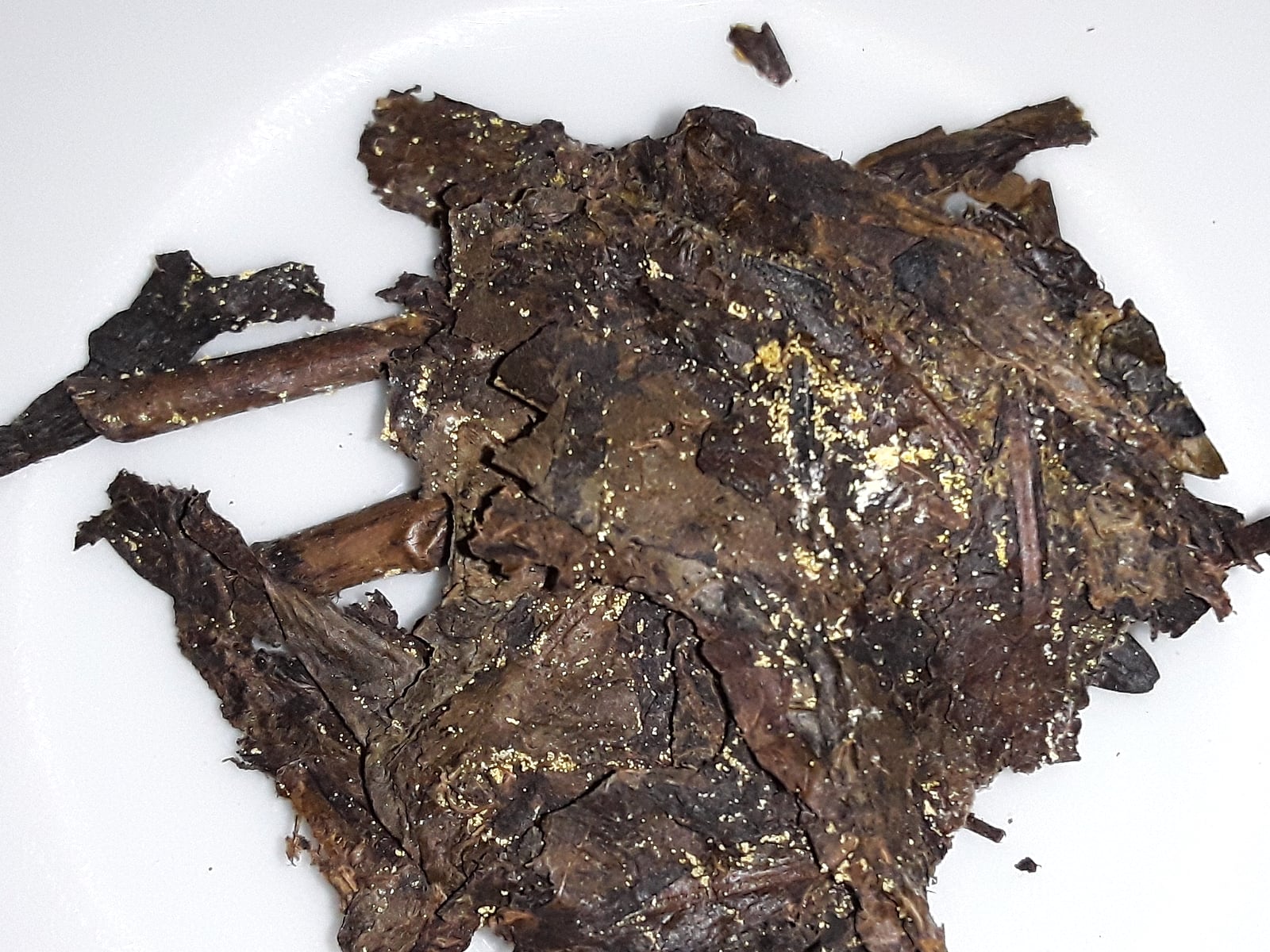
Fu brick tea develops "golden flowers" during processing. The flowers are the fungus Eurotium cristatum, which gives the tea its distinctive aroma. This is supported by the official museum and by People's Daily reporting. The fungus is not an additive, and not every Fu brick develops a good bloom; the outcome depends on humidity, temperature and the skill of the pressing and drying stages.
Jingyang Fu brick: local memory and verifiable facts
Jingyang was an important processing and distribution centre for Fu brick tea in the Ming and Qing periods. Local accounts use a four-part saying: "not without Jing water, not without midsummer heat, not without golden flowers, not without Jingyang." The China Fu Tea Culture Museum presents the origin story, pressing craft, the secret of the golden flowers and the Shaanxi tea merchants. It also mentions the year 1368 as a commemorative date. 1368 is the year the Ming dynasty was founded and is often used locally to mark the traditional beginning of Fu brick production. Treating it as the only origin date is not secure; a more careful statement is that Jingyang's Fu brick production and trade system matured in the Ming and Qing periods.
Brick tea had a long place in northwest and steppe trade, supported by documentary and ethnographic evidence. Herders break the brick, add milk and salt and boil it into milk tea. Tea provides flavour and, in traditional diets, some vitamins and minerals. But "one brick for one sheep" or "one camel load of bricks for one horse" are folk sayings, not a fixed exchange rate recorded in account books. This page does not present them as prices.
The Hexi Corridor: a corridor, not the only corridor
The classic overland description runs from Xi'an through Tianshui and Lanzhou into the Hexi Corridor, then through Wuwei, Zhangye, Jiuquan and Dunhuang. The Qilian Mountains rise to the south; deserts and gravel plains lie to the north. The oasis cities act as a chain of supply points. Dunhuang was one of the last oases before the road split at the Yang Pass and Yumen Pass, where caravans replenished water, fodder and grain.
The Hexi Corridor was not the only route. The Qinghai route, the Juyan route, the northern Tian Shan route and steppe routes rose and fell in different dynasties. Tea caravans did not necessarily travel all the way from Xi'an to Dunhuang as one unit. Calling the Hexi Corridor "the only passage" flattens a complex transport network into a line.
Central Asia, Persia and the Ottoman world: three markets, not one line
Samarkand, Bukhara and Almaty were long-standing entrepôts. Brick tea was traded alongside spices, cloth, horses and dried fruit; continuous statistics for the volume of tea are lacking. Tehran was one of Iran's centres of tea consumption and trade. Iranian tea culture developed through a long period of maritime and overland trade and later domestic planting. It cannot be reduced to a single "fifteenth-century introduction."
Istanbul connects the Black Sea, the Mediterranean and Anatolia. Coffee and tea became popular in succession during the Ottoman period, while modern Turkish black tea culture took shape in the republican period, when domestic tea growing was promoted and the double teapot and tulip-shaped glass became everyday objects. Describing Turkish tea as a direct continuation of Chinese brick-tea technique ignores the twentieth-century nation-building of the Turkish tea industry.
Moscow: the northern branch, not a continuation of Istanbul
In the seventeenth century, Russian tea arrived mainly through the Mongolia-Kyakhta-Siberian route, not by continuing north from Istanbul. The Russian word chai and the Chinese word cha are linguistic evidence of that exchange. The Russian samovar culture formed after tea consumption expanded in the Russian Empire. Placing Moscow after Istanbul is a choice made for the map; it is not the route of a historical caravan. The station table marks Moscow as the north branch and states that its distance is not added to the western line.
Route and scope
The schematic nodes are Xi'an (Chang'an) → Lanzhou → Dunhuang → Turpan → Ili → Almaty → Samarkand → Tehran → Istanbul; Moscow is the northern branch terminus. The station table gives about 7,000 kilometres and elevations from roughly 34 to 1,520 metres. These figures describe only the selected nodes, not the highest or lowest point of the whole network.
A historical caravan travelling by relay might take months to a year; the old page gives eight to twelve months. Actual time depended on season, water, inspections, cargo and changes of transport. Railways, highways and aircraft now cover the same directions, but a modern journey time cannot be converted directly into a historical one.
Stations
The stations below use the same node_id as the route fact table. The map and elevation profile are reading aids, not a substitute for field data.
01 · Xi'an · Chang'an
Chang'an was one of the eastern hubs of the Silk Road. Jingyang, nearby, was an important processing and distribution centre for Fu brick tea from the Ming and Qing periods onward, but calling it the single "birthplace" of Fu brick tea is not secure.
02 · Lanzhou
Lanzhou stands at the entrance to the Hexi Corridor, where the Yellow River crossing and the post road meet. The tea-horse exchange system became increasingly institutionalised in the Song and Ming periods; it should not be assigned simply to the Tang.
03 · Dunhuang
Dunhuang is the western oasis of the Hexi Corridor. Murals at Mogao show tea drinking in the Tang and Song periods and are useful image evidence for local tea culture, but they cannot be called the "earliest" evidence of tea spreading westward.
04 · Turpan
The Turpan Basin lies below sea level and was an important oasis on the northern Silk Road. The dating and nature of tea utensils found at Gaochang must be interpreted through archaeological reports; this page does not use them to declare the city a "key node" of tea transmission.
05 · Ili
The Ili valley was a military and trading centre on the northern Tian Shan route in the Qing dynasty. The place of brick tea and milk tea in Kazakh and Mongol pastoral life is documented in long-term ethnographic records.
06 · Almaty
Almaty is a trading city on the northern slope of the Tian Shan. The Green Bazaar still sells tea, dried fruit and livestock products, but it should not be called "the largest in Central Asia."
07 · Samarkand
Samarkand is an oasis city on the Zarafshan River and long served as a Central Asian entrepôt. Brick tea changed hands alongside spices and cloth; the scale of the trade is not documented in continuous statistics.
08 · Tehran
Tehran is one of Iran's centres of tea consumption and trade. Tea spread through a long period of maritime and overland exchange and domestic planting; it cannot be attributed to a single "fifteenth-century arrival."
09 · Istanbul
Istanbul links the Black Sea, the Mediterranean and Anatolia. Coffee and tea became popular in succession during the Ottoman period, while modern Turkish black tea culture formed in the republican era.
10 · Moscow
Moscow is the schematic terminus of the northern branch. In the seventeenth century Russian tea arrived mainly through the Mongolia-Kyakhta-Siberian route, not by continuing north from Istanbul; its distance is not added to the western line.
Trade teas
- Shaanxi Fu brick tea: Jingyang's traditional processing and distribution system; the golden flowers are Eurotium cristatum and develop naturally. The exact origin date is debated.
- Hubei Qing brick tea: an important border tea moving through Yangloudong, Hankou and Kyakhta; pressing and transport were well developed.
- Hunan Fu brick tea and Anhua dark tea: part of the Hunan dark-tea system linked to northwest and steppe trade. Anhua dark tea and Fu brick tea are not the same product and should not be merged.
- Longnan green tea: a Gansu producer recorded by the old page. It belongs to a different route and a different drinking context from the brick-tea trade.
Visiting notes
This page is a reading framework for a historical trade network, not a guide for cross-border walking, cycling or driving. Visa, border, language and security conditions differ across Central Asia, Iran, Turkey and Russia. For an actual visit, use official travel advisories and the opening information of museums and tea gardens. Coordinates and elevations in the station table come from legacy data and are partly approximate.
Sources
- People's Daily — where the golden flowers bloom, the scent of tea travels far
- Jinghe New City, Xixian New Area, Shaanxi — China Fu Tea Culture Museum
- Legacy migration data (route distances, duration and station narrative)